Lambda
First of all, we need to distinguish between Lambda and Lambda functions. Lambda is AWS service that invokes your Lambda functions.
Lambda functions invocation
A Lambda function can be either invoked synchrously or asynchronously. Based on the invocation type, the retry and error handling mechanism differs.
Synchronous invocation
When a function is invoked synchronously, Lambda runs the function and waits for a response.
Services that Invoke Lambda Functions Synchronously:
- ALB
- API Gateway
- CloudFront (Lambda@Edge)
- Step Functions
There is no automatic retry for the failed lambda functions except the functions that are invoked of Even source mapping.
Polling & Synchronous processing (Even source mapping)
Services that Lambda reads (poll) events from:
- DynamoDB
- Kinesis
- Amazon SQS
- Amazon MQ
- Apache Kafka
Lambda polls the queue or stream and invokes your Lambda function synchronously with an event that contains queue messages.
Lambda reads messages in batches and invokes your function once for each batch. When your function successfully processes a batch, Lambda deletes its messages from the queue. The batch size and batch window are configured inLambda triggers.
By default, if your function returns an error, the entire batch is reprocessed until the function succeeds, or the items in the batch expire.
For Kinesis data stream, you can either configure a failed destination in the Lambda triggers or specify a destination in Destination Configuration.
Destination Configuration (Kinesis & DynamoDB Stream)
- SQS queue
- SNS topic
- Lambda function
- EventBridge eventbug
For trigger a lambda function from a SQS queue, you can configure a DLQ for the failed items. Note, the DQL has to be configured in the source SQS queue.
“Make sure that you configure the dead-letter queue on the source queue, not on the Lambda function. The dead-letter queue that you configure on a function is used for the function’s asynchronous invocation queue, not for event source queues.“
Asynchronous invocation
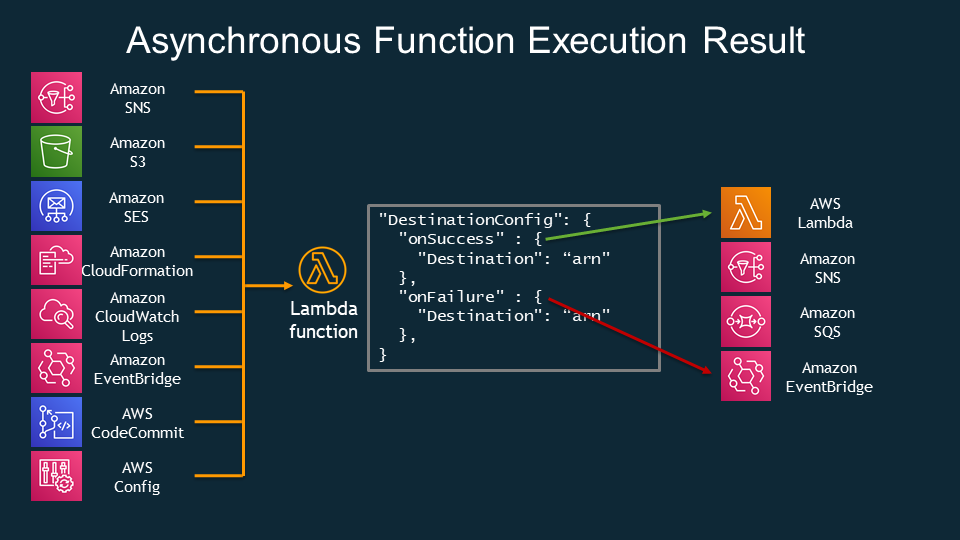
Services that invoke Lambda Functions Asynchronously:
- S3
- SNS
- CloudWath Logs
- CloudWath Events
- AWS Config
- CloudFormation
- AWS CodeCommit
- AWS CodePiplines
Asynchronous configuration
- Maximum age of event (60 seconds to 6 hours).
- Retry attempts (from 0 to 2)
If the event exceeds the maximum age of event or retry attemps, you can configure either a DLQ or a Destination to save the failed events. Otherwise the events are discarded.
Destination configuration
DLQ
- SQS queue
- SNS topic
Cloud Watch Event
Simply Serverless: Use constant values in Cloudwatch event triggered Lambda functions
VPC
How do I give internet access to a Lambda function that's connected to an Amazon VPC?